
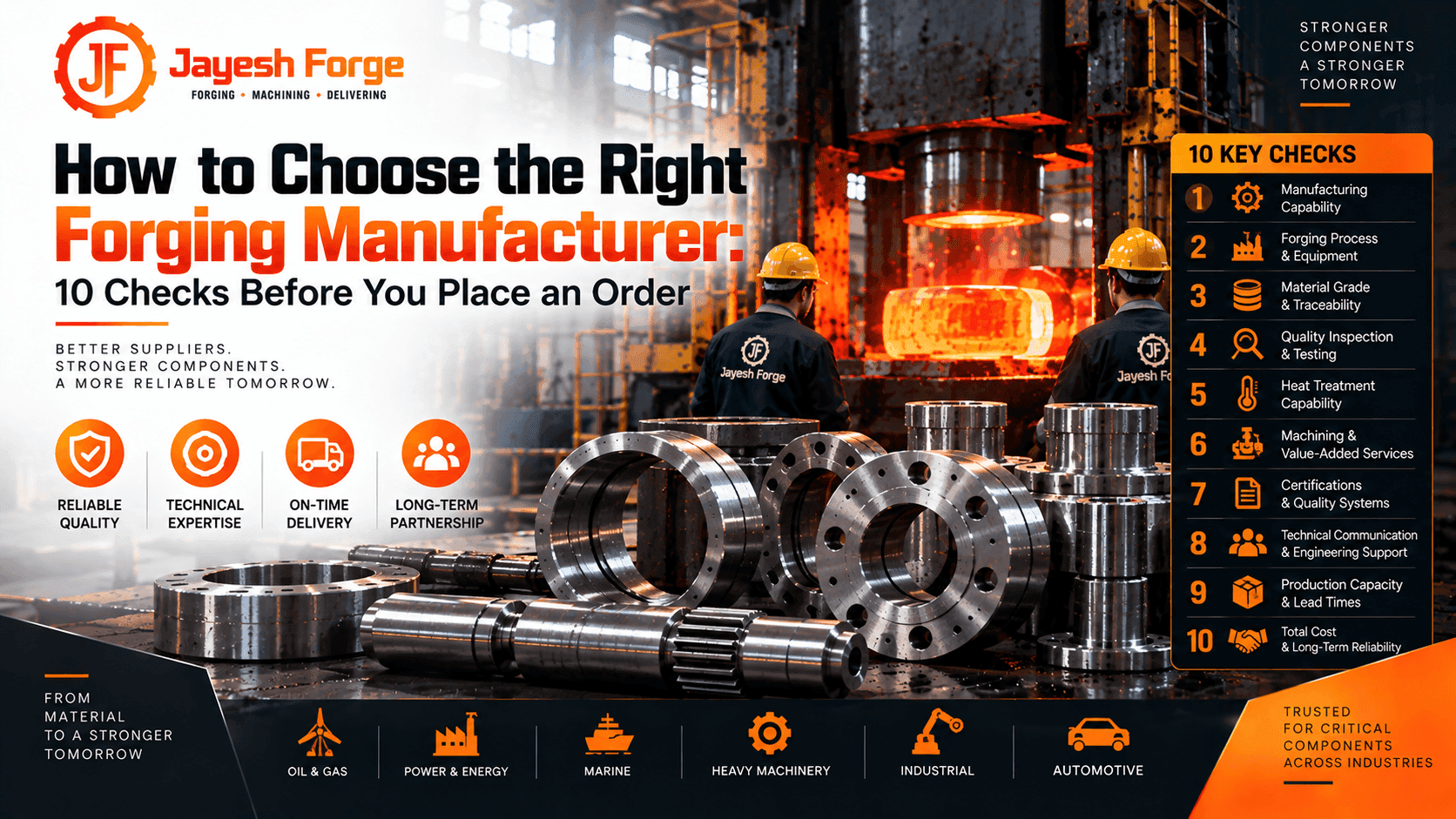
How to Choose the Right Forging Manufacturer: 10 Checks Before You Place an Order
Choosing a forging supplier involves more than comparing quotations. Use these 10 practical checks to evaluate manufacturing capability, quality systems, technical communication and long-term supply reliability.

Quick AnswerFeatured
Choosing a forging supplier involves more than comparing quotations. Use these 10 practical checks to evaluate manufacturing capability, quality systems, technical communication and long-term supply reliability.
When sourcing forged components, the lowest quotation does not always represent the best purchasing decision. A component may meet the drawing requirements only if the supplier can control the material, forging process, heat treatment, machining and inspection.
For procurement teams, the challenge is to identify a manufacturer that can meet the technical specification consistently, communicate clearly and deliver within the agreed commercial and production requirements.
This matters whether you are buying forged flanges, seamless rolled rings, gear blanks, bushes, shafts or custom components. The evaluation process should begin before the purchase order is released—not after a quality or delivery problem appears.
Here are ten practical checks to use when evaluating a forging manufacturer.
Key Takeaways
- Match the manufacturer's actual process capability to your component and drawing.
- Verify material specifications, certificates and identification controls.
- Review inspection methods and acceptance criteria before production.
- Confirm heat-treatment, machining and subcontracting arrangements.
- Compare quotations using the complete technical and commercial scope, not price alone.
1. Check Whether the Manufacturer Can Produce Your Component
Start with the component itself. A manufacturer experienced in small press forgings may not be suitable for a large ring, and a supplier that produces standard flanges may not have the tooling or process capability for a complex custom part.
Share the drawing and confirm:
- Component dimensions and finished weight.
- Material grade and product specification.
- Required manufacturing route.
- Quantity per order and expected annual volume.
- Machining and heat-treatment requirements.
- Critical tolerances and inspection requirements.
Ask the supplier to explain how the component would be manufactured and identify any technical limitations.
What to look for: A clear assessment of feasibility, tooling requirements, material availability and production planning—not a quotation based only on a brief product description.
2. Verify the Forging Process and Equipment
Different forging processes serve different component geometries and production needs.
| Process | Typical consideration |
|---|---|
| Open-die forging | Often used for larger or relatively simple shapes where suitable |
| Closed-die forging | Can produce repeatable, more complex shapes when appropriate tooling is available |
| Ring rolling | Used to produce ring-shaped components through controlled deformation |
| Hammer forging | Can suit a range of forged shapes depending on equipment and tooling |
| Friction or screw-press forging | Suitability depends on equipment capability, component geometry and process requirements |
The process list is a general guide. The appropriate route depends on the component design, dimensions, material, production volume and required properties.
Ask the manufacturer which process is proposed for your part and why. Where relevant, request evidence of suitable equipment capacity, tooling arrangements and experience with comparable components.
Do not assume that the presence of a particular machine guarantees that every component within its nominal size range can be manufactured successfully.
3. Confirm Material Grade and Traceability
Material control is fundamental to a reliable forging supply chain. A component made from the wrong grade may fail to meet the required mechanical, corrosion or heat-treatment characteristics even if its dimensions are correct.
Before placing an order, establish:
- The exact material grade and applicable standard.
- The required material condition.
- Whether a material test certificate is required.
- How incoming material is identified and segregated.
- How material identity is maintained during cutting and production.
- How the finished component is linked to its material records.
For critical applications, clarify how the supplier handles material substitutions and approval requests.
What to look for: A documented approach to material identification and records that can be matched to the delivered components.
4. Review the Quality Inspection Plan
Quality should be defined in measurable terms. Statements such as “good quality” or “100% quality checking” do not explain which characteristics are inspected, which methods are used or what acceptance criteria apply.
Depending on the specification, inspection may include:
- Dimensional verification.
- Chemical composition verification.
- Mechanical testing.
- Hardness testing.
- Visual inspection.
- Ultrasonic testing or other specified non-destructive testing.
- Final inspection reports.
Not every component needs every test. The correct inspection plan depends on the drawing, material specification, application and contractual requirements.
Ask the supplier to identify the inspection stages, responsible personnel, test methods, acceptance criteria and reporting format.
If a test must be performed by an external laboratory or specialist provider, clarify who arranges it and how the results are reviewed.
5. Understand Heat-Treatment Capability
Heat treatment can influence hardness, strength, toughness and machinability. The required process depends on the material grade, component size and intended material condition.
A supplier evaluation should establish whether heat treatment is performed in-house or through an external provider. Neither arrangement is automatically acceptable or unacceptable; the key is whether the process is suitable, controlled and traceable.
Ask:
- Which heat-treatment condition is required by the specification?
- Who performs the process?
- How are process records maintained?
- Which tests confirm the required properties?
- How are non-conforming results handled?
Avoid specifying a heat-treatment process without identifying the required final condition and acceptance criteria.
6. Check Machining and Dimensional Capability
A forged blank is not necessarily a finished component. Depending on the order, the supplier may need to provide rough machining, semi-finished machining or a fully machined part.
Confirm the scope clearly:
- Which surfaces and features will be machined?
- What machining allowance is included?
- Which dimensions and tolerances are critical?
- Are concentricity, runout, flatness or surface-finish requirements specified?
- Who verifies final dimensions?
- Are inspection reports included in the quotation?
If machining is subcontracted, confirm how component identification, drawing revision control and inspection records are maintained between operations.
A supplier that understands the full manufacturing route can help identify missing information before production begins.
7. Evaluate Production Capacity and Delivery Reliability
A manufacturer may be capable of making your part but unable to meet your required delivery schedule at the desired volume.
Discuss capacity and lead time using the actual order requirements.
Confirm:
- Normal production lead time.
- Tooling or sample-development lead time.
- Material procurement lead time.
- Expected batch size and production constraints.
- Inspection and documentation time.
- Packaging and dispatch arrangements.
- Procedures for communicating schedule changes.
For repeat orders, ask how production planning and raw-material availability are managed.
Avoid relying on an unqualified promise of immediate delivery. A realistic schedule should account for material, production, heat treatment, machining, inspection and dispatch.
8. Check Documentation and Compliance Requirements
Industrial buyers may require more than the physical component. The documentation package may be an essential part of order acceptance.
Depending on the contract, required records can include:
- Material test certificates.
- Heat-treatment records.
- Mechanical and hardness test reports.
- Dimensional inspection reports.
- NDT reports.
- Component marking and traceability records.
- Certificate of conformity.
- Packaging and dispatch documentation.
If a project specifies a particular standard, certification or approval, verify the supplier's actual status and scope. Do not assume that a general quality certificate automatically satisfies a project-specific requirement.
Agree on the document list before the order is placed, including the required format and delivery stage.
9. Compare Quotations on a Like-for-Like Basis
Two quotations can show different prices because their scopes differ. One may include machining, testing and documentation, while another may cover only the forged blank.
Use a comparison checklist before deciding.
| Commercial or technical item | What to confirm |
|---|---|
| Material | Exact grade, specification and delivery condition |
| Manufacturing | Forging route and included operations |
| Tooling | New tooling, modifications and ownership terms |
| Heat treatment | Included or excluded; required records |
| Machining | Rough, semi-finished or final machining |
| Inspection | Test methods, coverage and reports |
| Rejection handling | Agreed procedure for non-conforming parts |
| Packaging | Protection, marking and packing requirements |
| Delivery | Lead time, shipping terms and destination |
| Payment | Payment schedule and other commercial terms |
The goal is to compare equivalent technical scopes. A higher initial quotation may include work that another supplier has excluded, while a lower quotation may omit important requirements.
Evaluate total cost, quality risk, delivery performance and the effort needed to manage the supplier.
10. Evaluate Communication and Problem-Solving
Technical communication is often overlooked during supplier selection. However, clear communication can prevent drawing errors, specification gaps and avoidable delays.
Observe how the manufacturer handles questions such as:
- Are missing dimensions identified before quotation?
- Are proposed material or process changes submitted for approval?
- Are delivery risks communicated early?
- Are non-conformities documented and investigated?
- Are corrective actions explained clearly?
- Are drawing revisions controlled?
A dependable supplier should be willing to discuss limitations and seek clarification instead of making unapproved assumptions.
For custom forgings, this early exchange is especially important because tooling, material and manufacturing decisions can influence both cost and final component quality.
A Practical Forging Supplier Evaluation Checklist
Use this checklist during a supplier audit, technical meeting or RFQ review.
- Manufacturing process is suitable for the component.
- Equipment capability is confirmed for the required dimensions and material.
- Material grades and specifications are clearly defined.
- Material identification and traceability controls are established.
- Inspection methods and acceptance criteria are agreed.
- Heat-treatment responsibilities are confirmed.
- Machining scope and dimensional requirements are clear.
- Production capacity and lead time are realistic.
- Required quality documents are included in the scope.
- Quotation covers the complete technical and commercial requirement.
For a critical component, document the evaluation and resolve outstanding issues before approving the supplier.
Questions to Ask Before Placing a Forging Order
Before finalizing a purchase order, ask the manufacturer:
- Can you manufacture this component to the supplied drawing and material specification?
- Which manufacturing route do you propose?
- What information or approvals are still required?
- Which inspection and testing activities are included?
- How will material and component traceability be maintained?
- Which operations are subcontracted, if any?
- What is the realistic delivery schedule?
- Which certificates and reports will accompany the order?
- How will deviations or non-conforming parts be handled?
- What is excluded from the quotation?
Clear answers create a shared understanding between the buyer and supplier.
How Jayesh Forge Approaches Industrial Forging Enquiries
Jayesh Forge handles industrial forging requirements involving products such as forged flanges, seamless rolled rings, gear blanks, bushes and custom components, subject to the technical specification and manufacturing feasibility of each enquiry.
For a useful initial review, buyers should share the component drawing, material grade, dimensions, quantity, required delivery condition and inspection requirements.
These details help establish the proposed manufacturing scope and identify any technical points that need clarification before a quotation is finalized.
The final process, quality requirements, delivery schedule and documentation should be confirmed for each order rather than assumed from the component name alone.
Further Reading
- Open Die vs Closed Die Forging: Which Process Is Right for Your Component?
- Seamless Rolled Rings vs Welded Rings: What Is the Difference?
- Grain Flow in Forging: Why It Matters for Component Strength and Performance
- Flange Pressure Ratings Explained: ASME Class vs EN PN Ratings
- Heat Treatment of Forged Components: Why It Matters for Strength and Performance
- 42CrMo4 vs 20MnCr5: Which Steel Grade Is Right for Forged Components?
- How to Choose the Right Forged Flange for Oil & Gas Applications
- Wind Energy Forged Components: Critical Parts, Materials & Quality Requirements
- Stainless Steel 316L vs 304L Flanges: Differences, Applications & Material Selection
Industry Standards & References
- ASME (American Society of Mechanical Engineers)
- ASTM International (Materials & Standards)
- Forging Process Overview
Conclusion
Choosing the right forging manufacturer requires a structured assessment of technical capability, material control, quality inspection, heat treatment, machining, traceability and delivery performance.
A well-prepared RFQ and clear acceptance criteria help buyers compare suppliers fairly and reduce uncertainty before production begins.
The right supplier is not simply the one that offers the lowest price. It is the one that can meet the agreed requirements, communicate risks clearly and provide the evidence needed to verify conformity.
Looking for a Forging Manufacturing Partner?
Share your drawing, material specification, quantity and quality requirements with Jayesh Forge to discuss manufacturing feasibility and quotation scope.
Frequently Asked Questions
The supplier must be capable of meeting the component's technical requirements consistently. Process capability, material control, inspection, traceability and delivery performance should all be evaluated.
No. Compare equivalent technical scopes, including material, machining, heat treatment, inspection, documentation, tooling and delivery. Consider total cost and quality risk as well as the initial price.
Depending on the purchase specification, documents may include material certificates, heat-treatment records, mechanical test results, dimensional inspection reports, NDT reports and a certificate of conformity.
Not necessarily. In-house or outsourced heat treatment can be suitable if the process meets the required specification and the supplier can demonstrate appropriate control, traceability and verification.
Provide a controlled drawing revision, complete material specification, quantity, required tests and delivery target. Resolve technical questions and approval requirements before production starts.
Include the component drawing, material grade, dimensions, quantity, manufacturing scope, machining requirements, heat treatment, inspection criteria, documentation, delivery location and schedule.
Author
Jayesh Forge Engineering Team shares practical engineering insights on industrial forging, material selection, manufacturing processes, inspection, and quality requirements for engineers, procurement teams, and industrial buyers across global markets.
Submit Technical RFQ
Connect with our metallurgy experts for custom closed-die forgings strictly up to 50 kg per piece and seamless rolled rings manufactured in Rajkot, Gujarat with containerized sea export via Mundra and Kandla ports.
Request a Forging Quote→