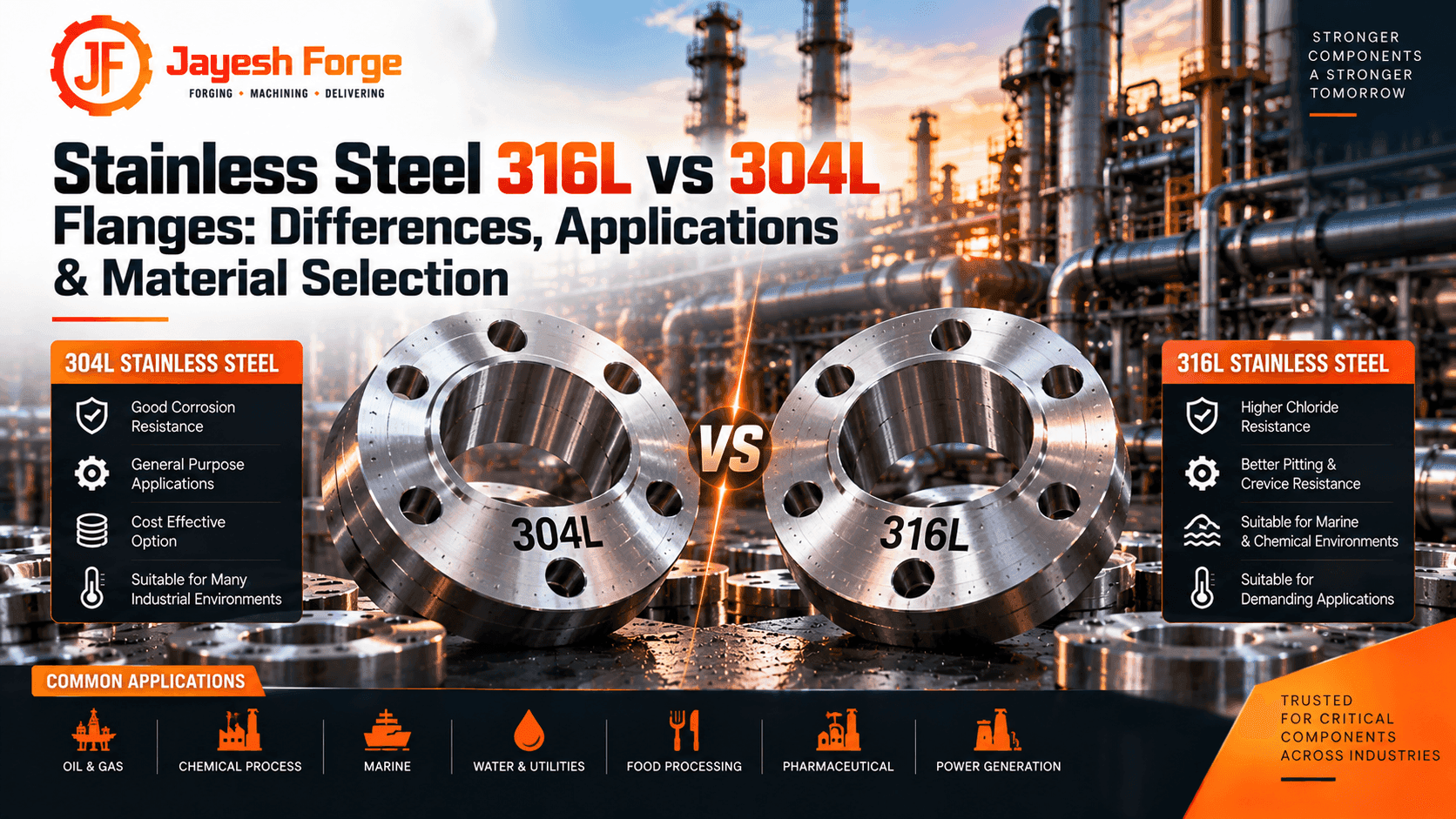
Stainless Steel 316L vs 304L Flanges: Differences, Applications & Material Selection
304L and 316L stainless steel flanges may look similar, but their alloy composition and corrosion resistance differ. Learn how to select the appropriate grade for your operating environment and application.

Quick AnswerFeatured
304L and 316L stainless steel flanges may look similar, but their alloy composition and corrosion resistance differ. Learn how to select the appropriate grade for your operating environment and application.
When sourcing stainless steel flanges, 304L and 316L are two grades that frequently appear in industrial specifications. Both belong to the austenitic stainless steel family and offer useful corrosion resistance, formability and weldability. However, they are not interchangeable in every application.
The main difference is molybdenum: 316L contains molybdenum, which generally improves resistance to pitting and crevice corrosion in chloride-containing environments compared with 304L. That difference can influence material selection in chemical processing, marine environments, water systems and other demanding services.
For procurement teams and engineers, the right choice depends on the operating environment, applicable flange standard, design requirements, material certification and total lifecycle cost—not simply the grade name.
Key Takeaways
- 316L generally offers better chloride resistance: Its molybdenum content helps improve resistance to pitting and crevice corrosion.
- 304L can be suitable for many general applications: It may be an economical choice where the environment and design specification permit it.
- The “L” indicates low carbon: Both grades have low-carbon versions that can help reduce sensitization concerns associated with welding.
- Material grade is only one part of flange selection: Pressure-temperature ratings, dimensions, flange type, facing and applicable standards must also be checked.
- Verify the material documentation: The delivered material must meet the specified grade and relevant product requirements.
1. What Is 304L Stainless Steel?
304L is a low-carbon version of 304 stainless steel. It is commonly used where a combination of general corrosion resistance, fabrication performance and availability is required.
The lower carbon content helps reduce the risk of sensitization during welding under relevant conditions. Sensitization can reduce corrosion resistance in affected areas of a stainless steel component.
Depending on the service environment and the applicable specification, 304L may be considered for:
- General industrial piping.
- Equipment and utility systems.
- Food-processing equipment.
- Selected water and process-fluid services.
- General-purpose stainless steel flanges and fittings.
These are examples, not blanket approvals. The fluid chemistry, temperature, cleaning chemicals and other operating conditions must be evaluated before selecting the material.
2. What Is 316L Stainless Steel?
316L is a low-carbon austenitic stainless steel that contains molybdenum. This addition generally improves its resistance to localized corrosion, particularly pitting and crevice corrosion in many chloride-containing environments.
It is commonly considered for applications such as:
- Selected chemical-processing systems.
- Marine and coastal equipment.
- Process piping exposed to suitable corrosive fluids.
- Equipment requiring improved resistance to certain chloride environments.
- Industrial systems where the design specification calls for 316L.
316L is not immune to corrosion. Chloride concentration, temperature, crevice geometry, deposits, surface condition and other factors can still cause corrosion or stress-corrosion cracking under certain conditions.
The material should therefore be selected against the actual service conditions rather than a general claim that 316L is suitable for all corrosive environments.
3. 304L vs 316L: Key Differences
| Selection factor | 304L stainless steel | 316L stainless steel |
|---|---|---|
| Alloy composition | Austenitic stainless steel; no intentional molybdenum addition in the usual grade definition | Austenitic stainless steel containing molybdenum |
| General corrosion resistance | Good in many suitable environments | Good in many suitable environments; often better in chloride-containing conditions |
| Pitting and crevice corrosion | More limited resistance in many chloride environments | Generally improved resistance due to molybdenum |
| Low-carbon designation | Yes | Yes |
| Fabrication and welding | Commonly used for fabricated components | Commonly used for fabricated components |
| Relative material cost | Often lower | Often higher |
| Typical selection consideration | General service where the specified environment permits | More demanding corrosion conditions where its additional resistance is beneficial |
Actual prices, properties and corrosion performance depend on product form, specification, supplier and service conditions. This table is a selection overview, not a substitute for the relevant material standard or engineering review.
4. Why Molybdenum Matters
Corrosion does not always appear as uniform material loss. In chloride-containing environments, localized damage can occur in the form of pitting or crevice corrosion.
Pitting creates small, concentrated cavities in the metal surface. Crevice corrosion can develop in shielded areas, such as beneath deposits or at tight component interfaces, where local chemistry differs from the surrounding environment.
The molybdenum in 316L generally improves resistance to these forms of localized corrosion compared with 304L.
However, grade selection should consider the complete system. A flange may be exposed to a process fluid, atmospheric moisture, cleaning chemicals or stagnant liquid trapped around a gasket. Each exposure can affect performance.
Where corrosion has serious safety or financial consequences, use service-specific corrosion guidance and qualified engineering assessment.
5. What Does the “L” Mean in 304L and 316L?
The letter “L” stands for low carbon.
Lower carbon content can reduce the likelihood of chromium carbide precipitation during certain thermal exposures, helping preserve corrosion resistance in susceptible areas near welds.
This is particularly relevant when components are welded or exposed to specified thermal cycles. The actual outcome depends on the material condition, welding procedure, thermal history and service environment.
The “L” designation does not automatically mean that a flange is stronger, more corrosion-resistant in every environment or suitable for every application. It identifies a particular composition requirement within the relevant grade specification.
6. How to Select the Right Grade for a Flange
Step 1: Identify the process fluid
Determine what the flange will contact. Water, seawater, chemicals, hydrocarbons and cleaning solutions can create very different corrosion conditions.
For mixtures or process streams, obtain reliable information about chloride concentration, pH, contaminants and other relevant chemical constituents.
Step 2: Confirm the operating conditions
Record operating and design temperatures, pressure, start-up and shutdown conditions, and any cleaning or maintenance cycles.
Temperature can affect corrosion behaviour and allowable pressure ratings. Material selection and flange pressure-temperature limits must be evaluated separately.
Step 3: Review the applicable flange standard
Identify the governing standard and required flange dimensions, pressure class or designation, type, facing and material specification.
For example, ASME B16.5 covers pipe flanges and flanged fittings within its stated scope. Other standards may apply depending on the project, dimensions and connection design.
Do not assume that a flange manufactured to one standard automatically matches another standard's dimensions or ratings.
Step 4: Check the material specification
The purchase order should clearly identify the required stainless steel grade and applicable product specification. The acceptable material form and grade must be appropriate for the intended flange and manufacturing route.
A generic request for “stainless steel flange” leaves important technical details unresolved.
Step 5: Consider lifecycle cost
A 316L flange may cost more initially than a comparable 304L flange. However, the material choice should account for corrosion risk, expected service life, maintenance, replacement access and downtime.
Conversely, selecting 316L when the service does not require its additional corrosion resistance may increase initial cost without a meaningful benefit.
The best choice is the grade that meets the engineering requirements at an appropriate total cost.
7. Forged Stainless Steel Flanges: What Buyers Should Check
Material selection is only one part of sourcing a forged flange. The component must also meet the required manufacturing and inspection criteria.
Before placing an order, confirm:
- Material grade: The exact grade and applicable product specification.
- Manufacturing route: The required product form and permitted manufacturing process.
- Flange dimensions: Nominal size, thickness, bolt-circle dimensions, bore and other drawing requirements.
- Pressure-temperature requirements: The applicable rating and design conditions.
- Facing: Raised face, flat face, ring-type joint or another specified configuration.
- Mechanical requirements: Any specified mechanical properties and testing.
- Corrosion considerations: Whether the service conditions require additional material or corrosion assessment.
- Traceability: Material identification and certificate requirements.
- Inspection: Dimensional checks and any specified non-destructive or other testing.
- Documentation: Inspection reports and certificates required by the purchase order.
Not every flange requires the same tests or documentation package. Define acceptance requirements before production to reduce misunderstandings and avoid late changes.
8. Common Mistakes When Purchasing 304L or 316L Flanges
- Choosing 316L based only on the word “corrosive”: Different corrosive environments behave differently. The presence of chloride, temperature, concentration and component geometry can change the result. Confirm the actual service conditions before selecting the grade.
- Assuming 304L and 316L are interchangeable: Their general appearance may be similar, but their composition and corrosion resistance differ. Substitutions should be approved through the project's technical change process.
- Ignoring the product specification: The correct alloy name alone may not define all requirements for a forged flange. Check the applicable standard, product form, delivery condition and certification.
- Confusing material grade with pressure class: A material grade does not determine the flange's complete pressure-temperature rating. Flange design, size, class, material group and the governing standard all matter.
- Forgetting traceability: For applications requiring quality documentation, ensure that the supplied component can be linked to the required material certificate and inspection records.
9. What Information Should You Send to a Flange Manufacturer?
A clear RFQ helps the supplier evaluate technical feasibility and provide a meaningful quotation.
Include:
- Component drawing and revision.
- Required grade: 304L, 316L or another approved material.
- Applicable flange and material standards.
- Nominal size, pressure class or PN designation, as applicable.
- Flange type and facing.
- Quantity and expected repeat-order volume.
- Operating environment and relevant service conditions.
- Required machining, testing and inspection.
- Material certificates and traceability requirements.
- Delivery location and target schedule.
If the material grade has not yet been finalized, state the operating conditions and request a technical review rather than leaving the grade ambiguous.
10. Stainless Steel Flange Requirements at Jayesh Forge
Jayesh Forge works with industrial forging requirements, including forged flanges and custom components specified by customers.
For stainless steel flange enquiries, provide the drawing, required grade, applicable standard, dimensions, quantity and inspection requirements. These details help establish the intended manufacturing scope and identify any technical information that must be confirmed before quotation.
Material availability, manufacturing feasibility, delivery condition and testing requirements should be verified for each order. The final supply specification should be agreed upon before production begins.
Further Reading
- Flange Pressure Ratings Explained: ASME Class vs EN PN Ratings
- How to Choose the Right Forged Flange for Oil & Gas Applications
- 42CrMo4 vs 20MnCr5: Which Steel Grade Is Right for Forged Components?
- Grain Flow in Forging: Why It Matters for Component Strength and Performance
- Heat Treatment of Forged Components: Why It Matters for Strength and Performance
- Open Die vs Closed Die Forging: Which Process Is Right for Your Component?
- Seamless Rolled Rings vs Welded Rings: What Is the Difference?
- Wind Energy Forged Components: Critical Parts, Materials & Quality Requirements
Industry Standards & References
- ASME (American Society of Mechanical Engineers)
- ASTM International (Materials & Standards)
- Stainless Steel Metallurgy & Grades
Conclusion
304L and 316L stainless steel flanges serve overlapping but distinct purposes. The molybdenum in 316L generally improves resistance to localized corrosion in many chloride-containing environments, while 304L may be an appropriate and economical option for suitable service conditions.
For reliable procurement, evaluate material grade alongside flange standard, pressure-temperature requirements, dimensions, manufacturing route, inspection and traceability. A complete specification helps the supplier quote accurately and reduces the risk of unsuitable substitutions.
Need Stainless Steel Forged Flanges for Your Application?
Share your drawing, material grade, flange standard and quantity with Jayesh Forge to discuss your forging requirements.
Frequently Asked Questions
No. 316L generally offers better resistance to pitting and crevice corrosion in many chloride-containing environments, but 304L can be suitable for many applications. The correct choice depends on the operating conditions and project specification.
Suitability depends on the exact exposure, chloride concentration, temperature, component geometry and maintenance conditions. In demanding marine exposures, 304L may be insufficient. A qualified material assessment should determine the appropriate grade.
They can be manufactured to the same dimensional standard and nominal size, but dimensions must be verified against the applicable standard and purchase specification. Similar dimensions do not make the materials interchangeable.
No. Stainless steel corrosion resistance varies with the chemical, concentration, temperature and operating conditions. Confirm compatibility for the actual process fluid and exposure.
A material test certificate documents specified information about the supplied material, which may include chemical composition and test results as required by the relevant specification. Buyers should verify that the certificate corresponds to the supplied grade and required documentation.
Start with the process fluid, operating conditions, design specification and applicable flange standard. If corrosion conditions are uncertain, obtain a materials-engineering review before finalizing the grade.
Author
Jayesh Forge Engineering Team shares practical engineering insights on industrial forging, material selection, manufacturing processes, inspection, and quality requirements for engineers, procurement teams, and industrial buyers across global markets.
Submit Technical RFQ
Connect with our metallurgy experts for custom closed-die forgings strictly up to 50 kg per piece and seamless rolled rings manufactured in Rajkot, Gujarat with containerized sea export via Mundra and Kandla ports.
Request a Forging Quote→