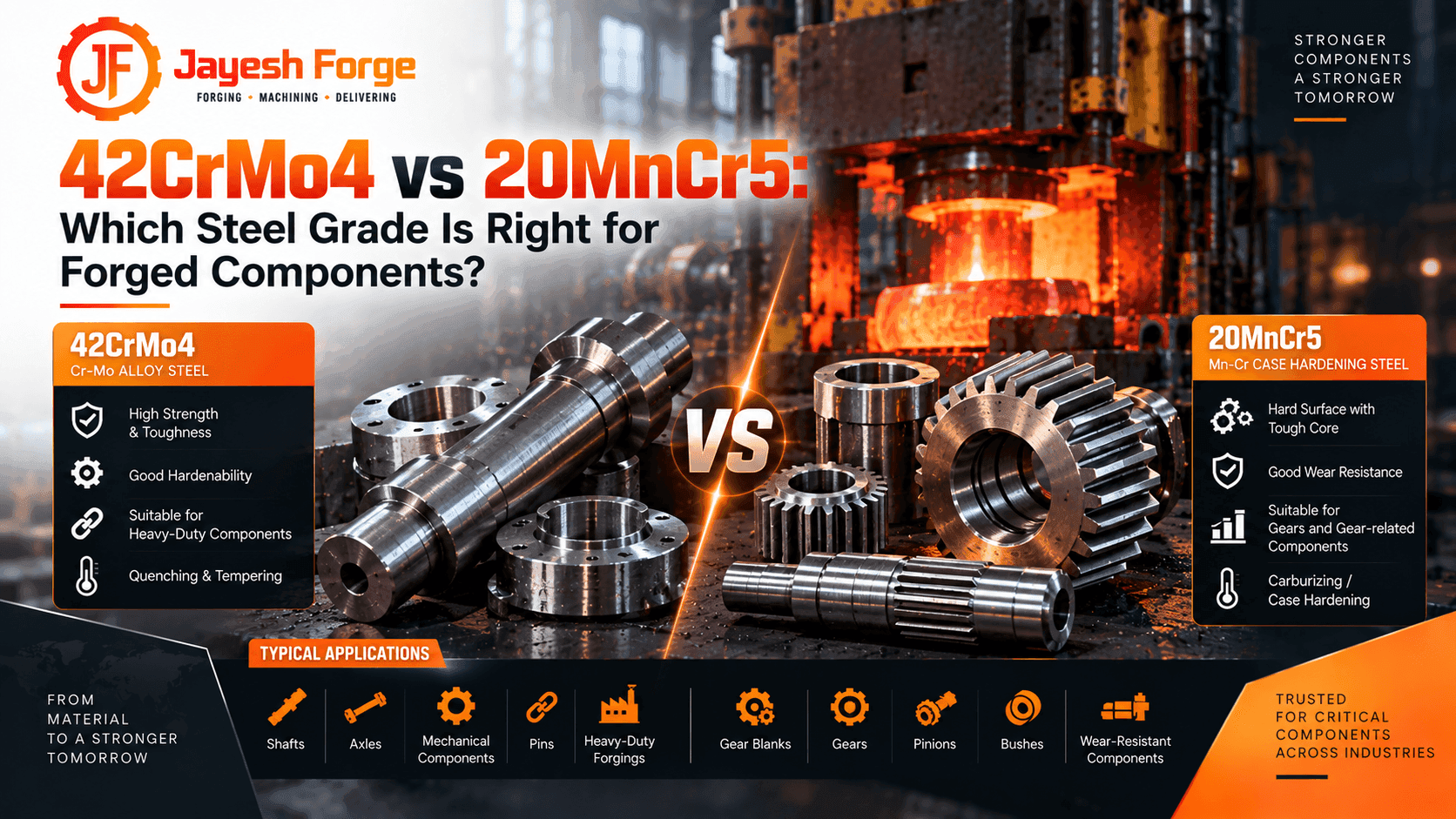
42CrMo4 vs 20MnCr5: Which Steel Grade Is Right for Forged Components?
42CrMo4 and 20MnCr5 are both widely relevant engineering steels, but they are selected for different component requirements. Understand the differences in material behaviour, heat treatment, surface hardness, core properties and typical applications before choosing a grade.

Quick AnswerFeatured
42CrMo4 and 20MnCr5 are both widely relevant engineering steels, but they are selected for different component requirements. Understand the differences in material behaviour, heat treatment, surface hardness, core properties and typical applications before choosing a grade.
Selecting the correct steel grade is one of the most important decisions when designing or sourcing a forged component.
Two grades that can appear in industrial forging requirements are 42CrMo4 and 20MnCr5.
Although both are alloy steels used for engineering applications, they are not interchangeable materials.
Their different alloying systems and heat-treatment characteristics make them suitable for different component requirements.
For engineers and procurement teams, the correct choice should be based on the component function, loading conditions, required hardness, core properties, surface requirements, heat treatment and final application.
Key Takeaways
- 42CrMo4 is a chromium-molybdenum alloy steel commonly selected where high strength and toughness are important.
- 20MnCr5 is a case-hardening steel commonly selected where a hard wear-resistant surface and tough core are required.
- The two grades should not be substituted simply because both can be forged.
- Heat treatment plays a major role in the final properties of both materials.
- Material selection should begin with the component's service requirements, not simply the lowest material cost.
What Is 42CrMo4?
42CrMo4 is a chromium-molybdenum alloy steel commonly used for mechanically loaded engineering components.
Its alloying system is designed to provide a combination of:
- High strength
- Good toughness
- Hardenability
- Wear resistance
- Suitable response to heat treatment
The grade is often considered for components where the bulk material properties are important.
Typical applications can include:
- Shafts
- Axles
- Gear-related components
- Pins
- Heavy-duty mechanical components
- High-strength forgings
The actual suitability depends on the required specification and heat-treatment condition.
What Is 20MnCr5?
20MnCr5 is a manganese-chromium alloy steel commonly associated with case-hardening applications.
The basic objective of case hardening is to develop:
Hard surface + Tougher core
This combination can be useful for components that experience surface contact, wear and mechanical loading.
Typical applications can include:
- Gear blanks
- Gears
- Shafts
- Pinions
- Bushes
- Other components requiring a hardened surface
Again, the actual application depends on the component design and specified heat-treatment route.
42CrMo4 vs 20MnCr5
| Factor | 42CrMo4 | 20MnCr5 |
|---|---|---|
| Steel type | Cr-Mo alloy steel | Mn-Cr case-hardening steel |
| Typical focus | Strength and toughness | Hard surface with tough core |
| Common treatment | Quenching and tempering | Carburizing/case hardening with suitable subsequent treatment |
| Surface hardness requirement | Depends on treatment | Commonly a major design objective |
| Core strength | High potential after suitable treatment | Designed to retain suitable core properties after case hardening |
| Typical components | Shafts, pins, axles, heavy-duty parts | Gears, pinions, gear blanks, wear-related components |
| Wear requirement | Depends on final condition | Particularly suitable for surface-wear applications |
| Selection priority | Bulk strength/toughness | Surface hardness + core performance |
This table provides a general engineering comparison. The actual material condition and properties should always be specified according to the applicable material standard and component requirement.
Why Is 42CrMo4 Used for Shafts?
Shafts can experience combinations of:
- Bending
- Torsion
- Tensile loading
- Fatigue
- Shock loading
For these applications, engineers may require a material with a suitable combination of strength and toughness throughout the component.
42CrMo4 can be considered when the design calls for high-strength alloy steel and an appropriate heat-treated condition.
However, the grade should be selected only after evaluating the actual loading and design requirements.
Why Is 20MnCr5 Used for Gears?
Gear teeth can experience significant surface contact and repeated loading.
The surface may need high hardness and wear resistance, while the core needs sufficient toughness to withstand operating loads.
This is where case-hardening steels such as 20MnCr5 can be useful.
A typical concept is:
Low-carbon alloy steel → Carburizing → Hard surface → Tougher core
The actual case depth, hardness and treatment requirements depend on the component specification.
Heat Treatment Is a Major Difference
Material grade alone does not determine the final component properties.
The heat-treatment route is equally important.
42CrMo4
A common engineering route for 42CrMo4 components is:
Forging → Normalizing or suitable conditioning → Quenching → Tempering → Machining/Inspection
The exact route depends on the required material condition and specification.
The purpose of quenching and tempering can be to establish the required balance of:
- Strength
- Hardness
- Toughness
- Ductility
20MnCr5
20MnCr5 is commonly associated with case-hardening applications.
A simplified route can be:
Forging → Machining/Preparation → Carburizing → Hardening → Tempering/Final treatment → Inspection
The actual sequence depends on the component, required case depth, hardness and applicable specification.
Surface Hardness vs Core Strength
This is one of the easiest ways to understand the difference.
42CrMo4
The design may focus on achieving suitable bulk mechanical properties through appropriate heat treatment.
20MnCr5
The design may focus on achieving a hard wear-resistant case while maintaining suitable core properties.
Therefore, asking:
"Which steel is stronger?"
is not always the correct question.
A better question is:
"Which material and heat-treatment condition provides the properties required by this component?"
Which Material Should You Choose?
Choose 42CrMo4 When:
The component primarily requires:
- High strength
- Good toughness
- High-strength shaft performance
- Resistance to mechanical loading
- Suitable through-section properties
- Quenched-and-tempered material condition
Typical examples may include:
- Shafts
- Axles
- Pins
- Heavy-duty mechanical components
Consider 20MnCr5 When:
The component requires:
- High surface hardness
- Wear resistance
- A hard case
- A tougher core
- Case-hardening treatment
Typical examples may include:
- Gear blanks
- Gears
- Pinions
- Certain shafts
- Other wear-critical components
The final decision should always be based on the engineering specification.
Forging Considerations
Both grades can be used in forging applications, but the manufacturing route must be controlled according to the material.
Important considerations include:
- Heating temperature
- Forging temperature range
- Reduction
- Deformation sequence
- Cooling after forging
- Heat treatment
- Machining allowance
- Final inspection
The forging manufacturer should have the material grade clearly defined before production begins.
How Does Component Geometry Affect Material Selection?
Material selection cannot be separated from geometry.
Consider two components:
Component A: Long shaft subjected to high torsional loading.
Component B: Gear blank requiring a hardened wear-resistant surface.
Even if both components are forged, their material requirements may be very different.
The correct decision therefore considers:
Geometry + Loading + Material + Heat Treatment + Service Conditions
rather than selecting the material based only on the component name.
What Should Procurement Teams Specify?
A purchase order or RFQ should avoid vague descriptions such as:
"Alloy steel forged shaft."
Instead, specify:
- Material grade
- Applicable material standard
- Forging condition
- Heat-treatment condition
- Mechanical properties
- Hardness requirements
- Case depth, where applicable
- Dimensional tolerances
- Inspection requirements
- NDT requirements
- Documentation requirements
For 20MnCr5 components requiring case hardening, the required case depth and hardness criteria should be clearly defined where applicable.
Inspection Requirements
Depending on the application, inspection can include:
- Chemical analysis
- Tensile testing
- Hardness testing
- Dimensional inspection
- Microstructure examination
- Case-depth measurement
- Ultrasonic Testing (UT)
- Magnetic Particle Inspection (MPI)
- Visual inspection
Not every component requires all of these tests.
The inspection plan should follow the drawing, applicable standard and customer requirements.
Common Material Selection Mistakes
Mistake 1: Treating 42CrMo4 and 20MnCr5 as Direct Substitutes
They have different material characteristics and typical heat-treatment objectives.
Mistake 2: Selecting Only by Tensile Strength
A gear may require surface hardness and wear resistance rather than simply maximum bulk tensile strength.
Mistake 3: Ignoring Heat Treatment
The final properties depend heavily on the specified material condition and treatment.
Mistake 4: Not Defining Case Depth
For case-hardened components, surface hardness alone may not adequately define the requirement.
Mistake 5: Changing Grade Without Engineering Approval
A material substitution should be reviewed against the component design, applicable specification and customer requirements.
What Information Should You Send for a Material-Specific Forging RFQ?
For accurate technical evaluation, provide:
- Component drawing
- Material grade
- Applicable standard
- Finished dimensions
- Forging weight
- Quantity
- Heat-treatment requirement
- Required hardness
- Mechanical properties
- Case depth, if applicable
- Machining requirements
- Inspection requirements
- NDT requirements
- Delivery schedule
A complete RFQ allows the manufacturer to evaluate both the forging route and material-processing requirements.
How Jayesh Forge Approaches Material Selection
At Jayesh Forge, material selection is evaluated according to the component drawing, application, production quantity and required material properties.
Our forging capabilities include friction screw press forging and CNC ring rolling, supporting products such as:
- Gear blanks
- Forged flanges
- Seamless rolled rings
- Bushes
- Rings
- Custom industrial forgings
For a new requirement, the material grade, component geometry, quantity, heat treatment and inspection requirements provide the basis for evaluating the manufacturing route.
Conclusion
42CrMo4 and 20MnCr5 can both be relevant to forged industrial components, but they solve different engineering requirements.
42CrMo4 is commonly considered when high strength and toughness are important throughout the component.
20MnCr5 is commonly considered when a hard, wear-resistant surface combined with suitable core properties is required.
The right choice should therefore be based on component geometry, loading, material properties, heat treatment, surface requirements and service conditions.
For engineers and procurement teams, specifying the material grade alone is not enough. The complete material condition, heat treatment, mechanical properties and inspection requirements should be clearly defined.
Looking for Alloy Steel Forgings?
Have a shaft, gear blank, pinion, ring or custom forging requirement?
Share your drawing, material grade, quantity, heat-treatment condition and inspection requirements with Jayesh Forge.
Our engineering team can review your requirement and discuss a suitable forging and manufacturing route.
Frequently Asked Questions
There is no single answer without specifying the heat-treatment condition and required property. 42CrMo4 is commonly selected for high-strength applications, while 20MnCr5 is commonly selected where a hard case and suitable core properties are required.
20MnCr5 is commonly considered for gears and pinions where case hardening and surface wear resistance are important. The final choice should follow the gear design and applicable specification.
42CrMo4 can be a suitable choice for high-strength shafts, particularly where strength and toughness are important. However, the correct grade depends on shaft geometry, loading and service requirements.
Not automatically. Their material characteristics and typical heat-treatment routes are different. Any substitution should be technically evaluated and approved where required.
Case hardening can produce a hard, wear-resistant surface while retaining suitable core properties, making the material useful for components such as gears and pinions.
Author
Jayesh Forge Engineering Team shares practical engineering insights on industrial forging, material selection, manufacturing processes, inspection, and quality requirements for engineers, procurement teams, and industrial buyers across global markets.
Submit Technical RFQ
Connect with our metallurgy experts for custom die estimates, material substitution, or seamless rolled ring production.
Request a Forging Quote→