
Open Die vs Closed Die Forging: Which Process Is Right for Your Component?
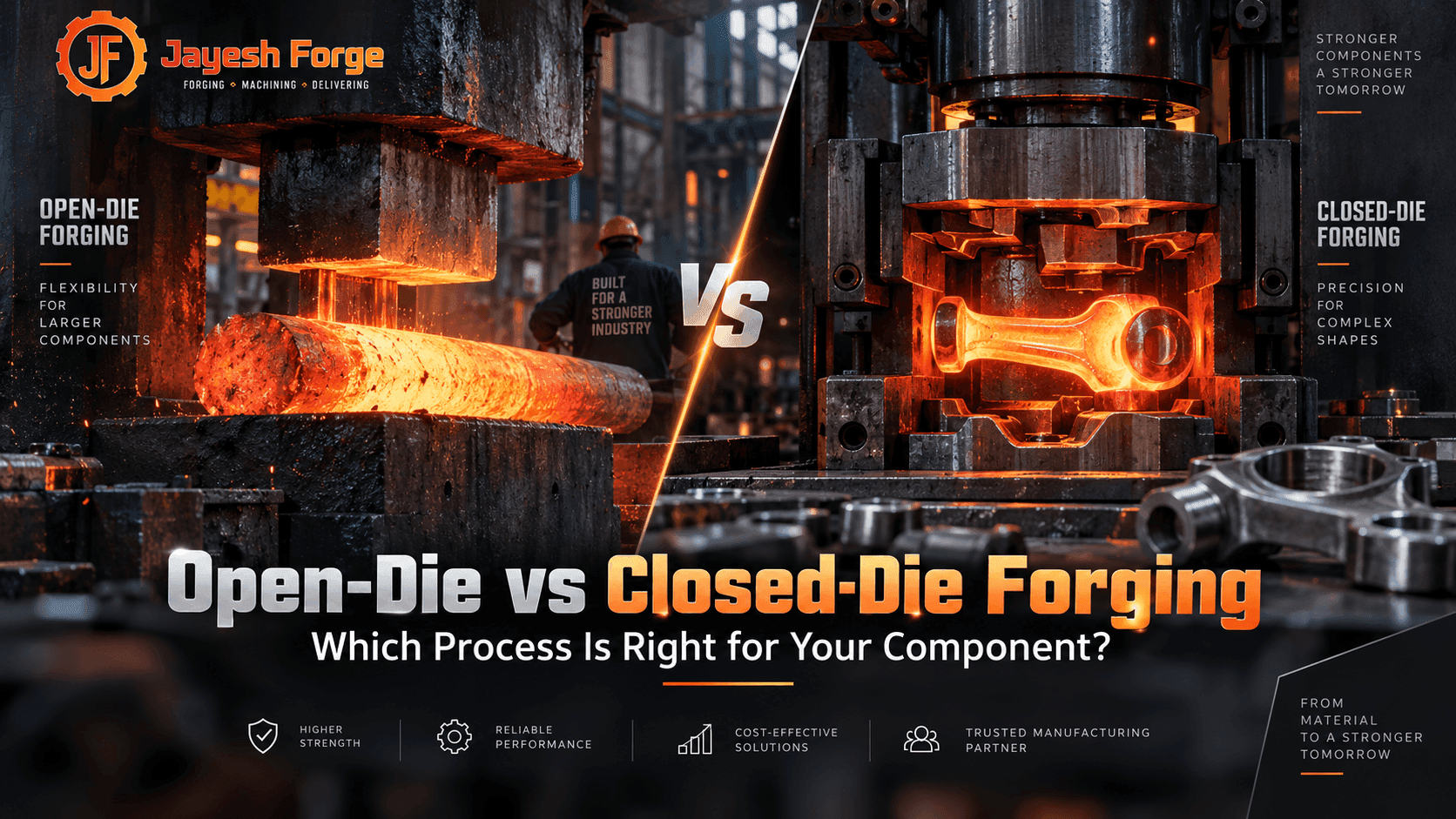
Choosing between open-die and closed-die forging depends on more than component shape. Size, geometry, material, production quantity, tooling, grain flow, machining requirements, tolerances, and the final application all influence the right manufacturing route.

Quick AnswerFeatured
Choosing between open-die and closed-die forging depends on more than component shape. Size, geometry, material, production quantity, tooling, grain flow, machining requirements, tolerances, and the final application all influence the right manufacturing route.
Key Takeaways
- Open-die forging provides flexibility for large and relatively simple components, including shafts, blocks, discs, and rings.
- Closed-die forging is suited to repeatable, controlled geometries where dedicated tooling is justified.
- Grain flow can be an important advantage of forging, but final component performance also depends on material, reduction, heat treatment, machining, and inspection.
- Tooling economics become particularly important when selecting between processes for different production quantities.
- The right process should be selected based on the complete component requirement, not simply the lowest forging cost.
What Is Open-Die Forging?
In open-die forging, heated metal is compressed between dies that do not completely enclose the workpiece. The material is allowed to move laterally as force is applied, and the component is progressively shaped through controlled forging operations.
Common open-die operations include:
- Upsetting
- Drawing out
- Cogging
- Fullering
- Edging
- Step forging
Open-die forging is commonly considered for:
- Large shafts
- Blocks
- Discs
- Rings
- Step shafts
- Heavy machinery components
- Large industrial forgings
One of its key advantages is process flexibility. The same general tooling approach can be used for different component sizes and geometries without requiring a dedicated impression die for every component.
What Is Closed-Die Forging?
Closed-die forging, also known as impression-die forging, forms heated material inside shaped die cavities.
As the dies close, the material flows into the cavity and progressively takes the required geometry. This allows manufacturers to produce repeatable shapes with controlled dimensions.
Closed-die forging is commonly used for components such as:
- Gear blanks
- Connecting rods
- Hubs
- Flanges
- Levers
- Yokes
- Automotive components
- Custom-shaped forgings
The major consideration is tooling. A dedicated die normally needs to be designed and manufactured for the required component geometry.
Open-Die vs Closed-Die Forging
| Factor | Open-Die Forging | Closed-Die Forging |
|---|---|---|
| Die arrangement | Dies do not fully enclose the material | Material is formed within die cavities |
| Geometry | Simple to moderately complex | Moderate to highly controlled geometry |
| Component size | Well suited to large components | Generally suited to smaller/medium components, depending on equipment |
| Tooling | Lower and simpler | Dedicated tooling normally required |
| Initial tooling investment | Generally lower | Generally higher |
| Production volume | Low to medium volumes can be economical | Higher volumes can justify tooling |
| Dimensional control | Depends on process and operation | Generally better for repeatable shaped components |
| Flexibility | High | Lower once dedicated tooling is established |
| Typical products | Shafts, blocks, discs, rings | Gear blanks, connecting rods, hubs, shaped parts |
Why Does Grain Flow Matter in Forging?
One of the important characteristics of forging is the way deformation can influence the grain flow of the material.
During forging, the metal is plastically deformed into the required shape. With an appropriately designed forging process, grain flow can be oriented in a way that follows important features of the component.
This can be particularly relevant for components subjected to repeated or directional loading.
However, grain flow should not be considered in isolation.
Final component performance also depends on:
- Material grade
- Forging reduction
- Forging temperature
- Heat treatment
- Machining
- Surface condition
- Inspection requirements
Therefore, a forging specification should consider the complete manufacturing route rather than relying on grain flow alone.
Component Size and Geometry
Component size is one of the first factors to evaluate.
Open-die forging can provide greater flexibility for larger components where a dedicated cavity may not be practical.
Closed-die forging becomes attractive when the component has a repeatable geometry that can be efficiently formed using a dedicated die.
For example:
Large shaft → Open-die route may be considered
High-volume shaped component → Closed-die route may be considered
Large seamless ring → Ring rolling may be considered
The final process should be determined from the component drawing, material, dimensions, quantity, tolerances and application.
Tooling and Production Volume
Tooling is one of the biggest differences between open-die and closed-die forging.
Open-die forging generally requires simpler tooling, which can make it suitable for:
- Prototype components
- Low-volume production
- Large components
- Multiple component sizes
- Custom industrial forgings
Closed-die forging normally requires dedicated tooling. The initial tooling investment can therefore be higher.
However, when production volumes are sufficiently high, the tooling cost can be distributed across a larger number of components.
This means the cheapest process cannot be determined only by the initial tooling price.
A better calculation considers:
Raw material + forging + tooling + heat treatment + machining + inspection + rejection risk + logistics
Materials Used for Forging
Both open-die and closed-die forging can be used with a range of engineering materials, depending on equipment and process capability.
Common materials include:
- Carbon steel
- Alloy steel
- Stainless steel
- Aluminium alloys
- Copper alloys
- Brass
The material grade should be selected according to the component's mechanical, chemical, temperature, corrosion and service requirements.
The forging process must then be controlled according to the selected material and applicable specification.
How Do You Select the Right Forging Process?
Before selecting open-die or closed-die forging, ask five basic questions:
1. What is the component size?
Large dimensions and heavy weights may influence the choice toward an open-die or other suitable large-component process.
2. What is the production quantity?
Low-volume and custom requirements may favor flexible processes, while higher-volume production can justify dedicated tooling.
3. How complex is the geometry?
More complex and repeatable geometries may justify closed-die tooling.
4. How much machining is required?
The forging design should consider machining allowances and the final machined geometry.
5. What is the final application?
Oil & gas, automotive, wind energy, marine, power and heavy machinery components may have different requirements for material, inspection, mechanical properties and traceability.
What Information Should You Provide in a Forging RFQ?
A complete RFQ helps a forging manufacturer evaluate the correct manufacturing route.
Ideally, provide:
- 2D component drawing
- 3D CAD model, if available
- Material grade
- Applicable material standard
- Finished dimensions
- Finished weight
- Required quantity
- Heat-treatment requirements
- Machining requirements
- Dimensional tolerances
- Inspection requirements
- Testing requirements
- Delivery location
- Required delivery schedule
Inspection requirements may include:
- Material Test Certificate (MTC)
- Chemical analysis
- Mechanical testing
- Hardness testing
- Dimensional inspection
- Ultrasonic Testing (UT)
- Magnetic Particle Inspection (MPI)
- Third-party inspection
The more complete the technical information, the easier it is for the manufacturer to evaluate the process and provide a reliable quotation.
Applications of Forging
Forging is used across many industrial sectors where component strength, reliability and controlled manufacturing are important.
Oil & Gas
Forged components can be used in demanding applications where material quality, pressure requirements and inspection are important.
Typical requirements may include forged flanges, rings, connectors and other pressure-related components.
Automotive
Forging is widely used for components such as:
- Gear blanks
- Hubs
- Shafts
- Connecting rods
- Flanges
- Couplings
Production volume and repeatability are often important considerations.
Wind Energy
Large rings and other forged components can be required for wind-energy equipment.
For these applications, component size, material properties, dimensional accuracy, heat treatment and inspection requirements must be considered together.
Heavy Machinery
Heavy machinery can require large shafts, bushes, rings, blocks and other custom forgings.
For these components, process flexibility and the ability to manufacture according to drawing requirements can be important.
How Jayesh Forge Approaches Forging Requirements
At Jayesh Forge, the manufacturing route is evaluated according to the component specification rather than applying the same process to every requirement.
Our capabilities include friction screw press forging and CNC ring rolling, supporting products such as:
- Forged flanges
- Seamless rolled rings
- Gear blanks
- Bushes
- Rings
- Custom industrial forgings
Depending on the component specification, material requirements can include carbon steel, stainless steel, alloy steel and selected non-ferrous materials.
For a new requirement, the drawing, material grade, production quantity and inspection requirements provide the starting point for evaluating the appropriate manufacturing route.
Conclusion
Open-die and closed-die forging are not competing processes where one is universally better than the other.
The right choice depends on the component size, geometry, material, production quantity, tooling requirements, machining requirements and final application.
For large and flexible custom components, open-die forging can provide useful manufacturing flexibility. For repeatable shaped components where dedicated tooling is justified, closed-die forging can provide controlled and consistent geometry.
The most reliable approach is to evaluate the complete manufacturing route before selecting a process.
Looking for a Forging Manufacturer in India?
Have a component drawing or forging requirement?
Share your drawing, material grade, quantity and inspection requirements with Jayesh Forge.
Our engineering team can review your requirement and discuss a suitable forging and manufacturing route for your application.
Further Reading
- Seamless Rolled Rings vs Welded Rings: What Is the Difference?
- Grain Flow in Forging: Why It Matters for Component Strength and Performance
Industry Standards & References
- ASME (American Society of Mechanical Engineers)
- ASTM International (Materials & Standards)
- Forging Process Overview
Looking for Custom Forgings?
Have a custom forging requirement?
Share your drawing, material grade, dimensions, quantity and inspection requirements with Jayesh Forge.
Our engineering team can review your requirement and discuss a suitable manufacturing route.
Frequently Asked Questions
Not always. Open-die forging can have lower initial tooling requirements, while closed-die forging can become economical for higher production volumes because dedicated tooling supports repeatable production.
Open-die forging is commonly considered for large components, but the actual process depends on component dimensions, weight, geometry, material and available equipment.
Not necessarily. The appropriate process depends on the component requirement. Forging quality depends on process design, material, reduction, temperature control, heat treatment, machining and inspection.
Yes. Forgings commonly include machining allowances and may undergo turning, milling, drilling, boring, grinding or other machining operations to achieve final dimensions.
A drawing, material grade, quantity, dimensions, weight, heat-treatment requirements, machining requirements and inspection/testing requirements provide a strong starting point for a forging RFQ.
Author
Jayesh Forge Engineering Team shares practical engineering insights on industrial forging, material selection, manufacturing processes, inspection, and quality requirements for engineers, procurement teams, and industrial buyers across global markets.
Submit Technical RFQ
Connect with our metallurgy experts for custom die estimates, material substitution, or seamless rolled ring production.
Request a Forging Quote→Related Articles
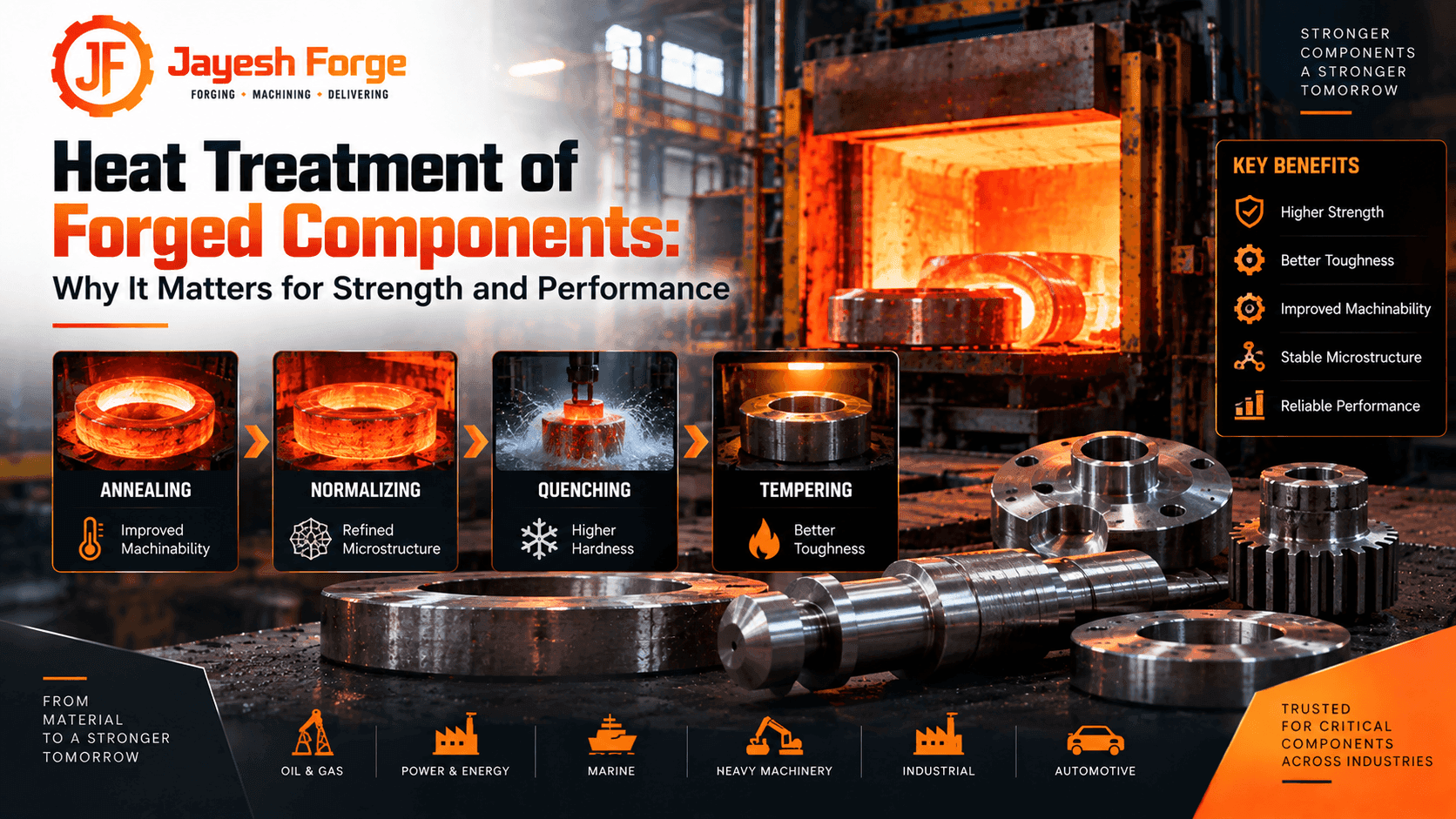
Heat Treatment of Forged Components: Why It Matters for Strength and Performance
Forging creates the component shape, but heat treatment helps achieve the required material condition and mechanical properties. Understand common heat-treatment processes and what engineers should specify when sourcing forged components.
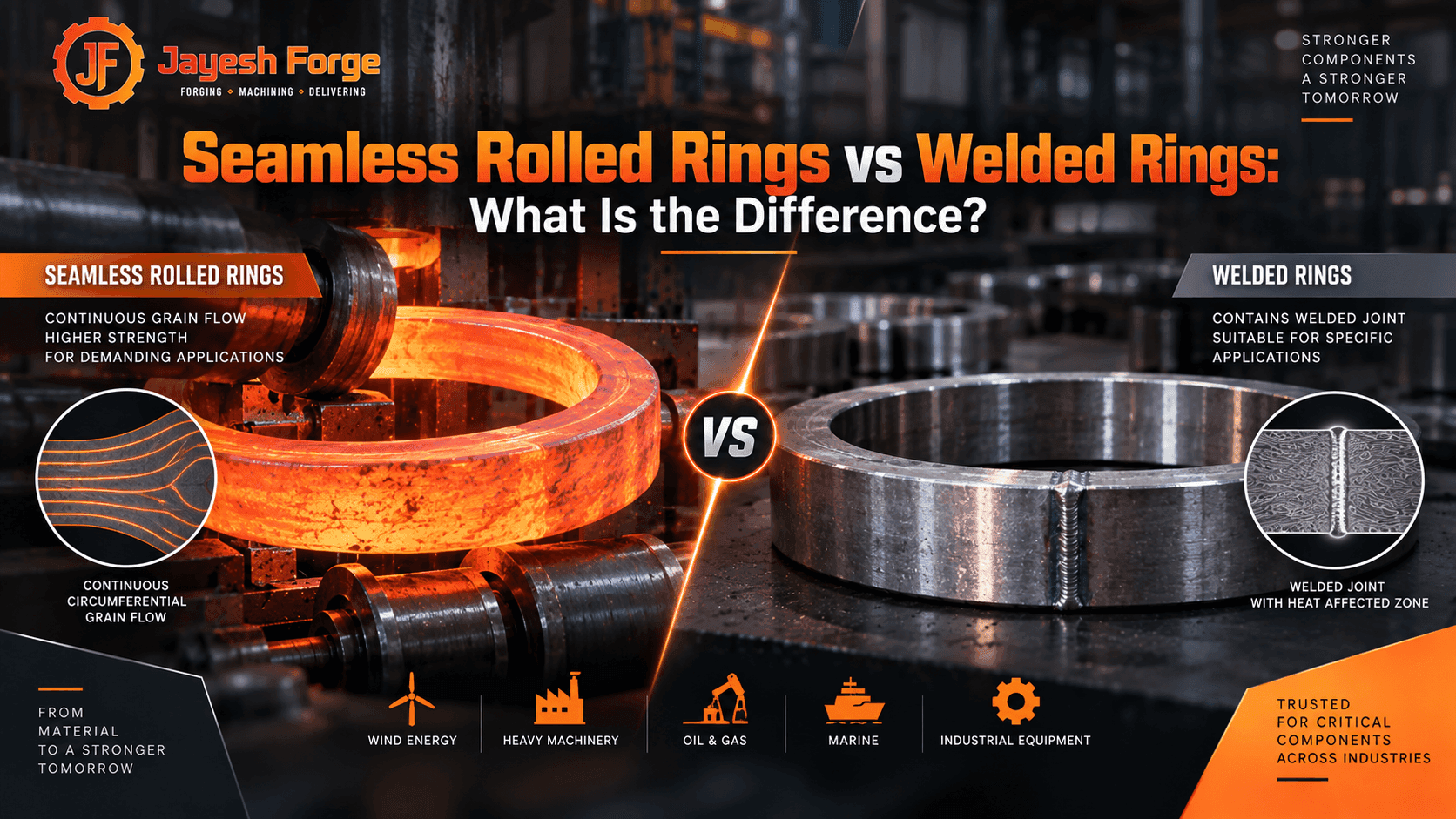
Seamless Rolled Rings vs Welded Rings: What Is the Difference?
Seamless rolled rings and welded rings can look similar after machining, but their manufacturing routes are fundamentally different. Learn how ring rolling, welding, grain flow, inspection and application requirements influence ring selection.