
Seamless Rolled Rings vs Welded Rings: What Is the Difference?
Seamless rolled rings and welded rings can look similar after machining, but their manufacturing routes are fundamentally different. Learn how ring rolling, welding, grain flow, inspection and application requirements influence ring selection.
Quick AnswerFeatured
Seamless rolled rings and welded rings can look similar after machining, but their manufacturing routes are fundamentally different. Learn how ring rolling, welding, grain flow, inspection and application requirements influence ring selection.
Key Takeaways
- Seamless rolled rings are produced through a forging and ring-rolling process, without a welded joint in the finished ring.
- Welded rings contain a welded joint, so weld quality and heat-affected-zone considerations become important.
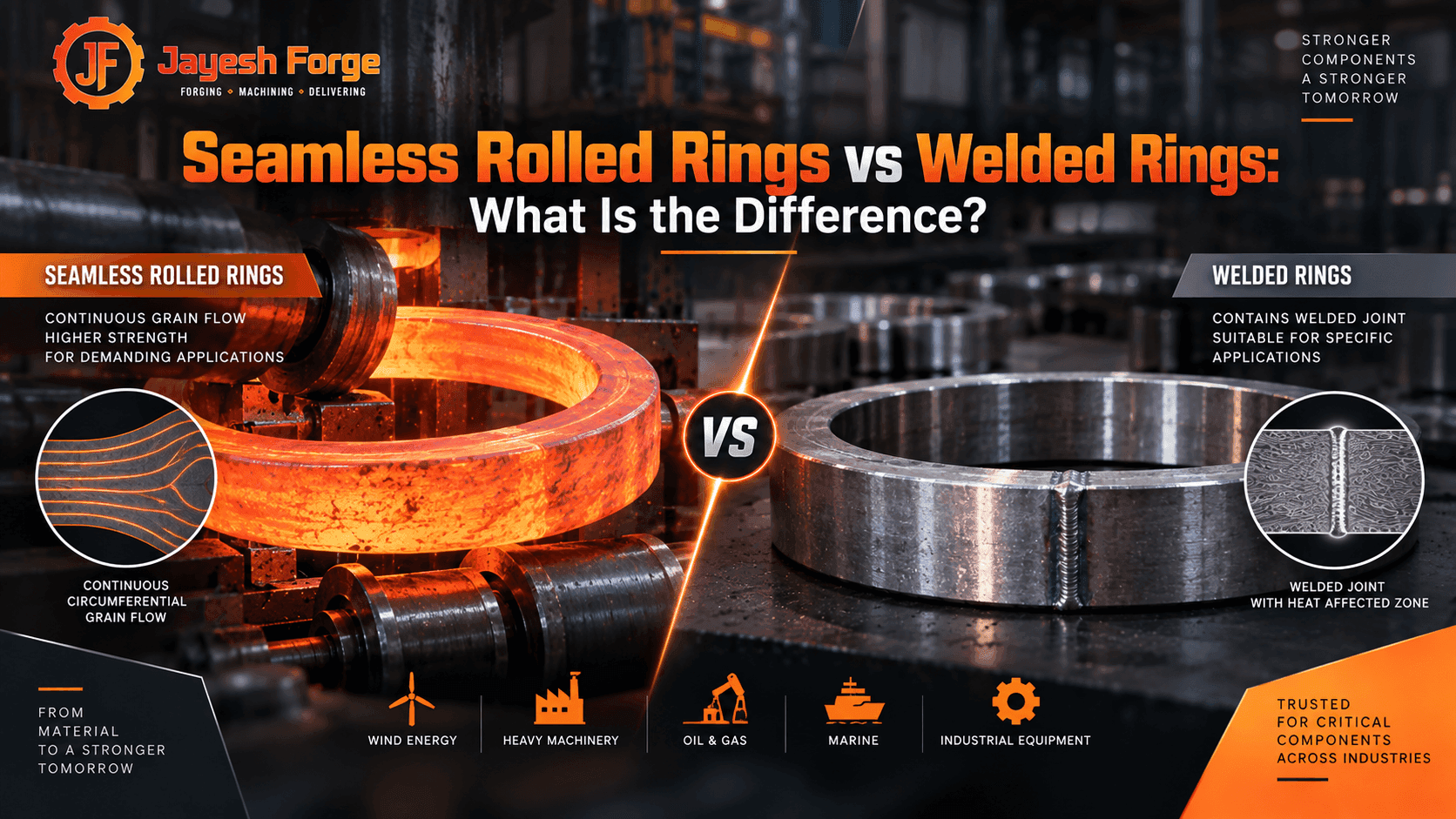
- Ring rolling can develop continuous circumferential grain flow around the ring.
- The appropriate ring depends on the material, geometry, loading, application, inspection requirements and production quantity.
- Procurement teams should compare the complete manufacturing route and technical requirements, not only the purchase price.
What Is a Seamless Rolled Ring?
A seamless rolled ring is produced from a forged preform that is progressively rolled to achieve the required diameter, wall thickness and height.
A simplified manufacturing route is:
Billet → Heating → Forging → Ring Preform → Ring Rolling → Heat Treatment → Machining → Inspection
During ring rolling, the ring is continuously deformed between rolls.
The diameter increases while the cross-section is reduced and controlled according to the required dimensions.
One important characteristic of this process is the development of circumferential material flow around the ring.
What Is a Welded Ring?
A welded ring is produced by joining material together to create a continuous circular component.
Depending on the manufacturing method, a welded ring may involve:
- Plate or strip preparation
- Forming or bending
- Joint preparation
- Welding
- Heat treatment where specified
- Machining
- Weld inspection
The welded joint becomes an important part of the component's manufacturing and inspection requirements.
The quality of the ring therefore depends not only on the base material but also on the welding procedure and control of the welded joint.
Seamless Rolled Ring vs Welded Ring
| Factor | Seamless Rolled Ring | Welded Ring |
|---|---|---|
| Manufacturing route | Forging + ring rolling | Forming + welding |
| Weld joint | No welded joint in the ring | Contains a welded joint |
| Material flow | Developed through forging and ring rolling | Influenced by original material and forming process |
| Grain flow | Can follow the circumferential ring geometry | Does not have the same continuous forged-ring flow |
| Weld inspection | Not applicable to a weld joint | Weld inspection may be required |
| Tooling/process | Ring rolling equipment required | Forming and welding equipment required |
| Typical consideration | Forged, load-bearing ring applications | Applications where welded construction is suitable |
| Production economics | Depends on size, material and quantity | Depends on material, welding and quantity |
The actual suitability of either route depends on the component specification and service requirements.
How Are Seamless Rolled Rings Manufactured?
The manufacturing process begins with suitable raw material.
1. Material Preparation
The starting material is selected according to the required material grade and component specification.
2. Heating
The material is heated to a suitable forging temperature for the selected grade and process.
3. Preform Forging
The heated material is forged into a suitable ring preform.
4. Ring Rolling
The preform is placed into the ring rolling equipment.
The ring is progressively rolled to increase its diameter while controlling the cross-sectional dimensions.
5. Heat Treatment
The ring may undergo a specified heat-treatment process depending on the material and required properties.
6. Machining
The forged ring can then be machined to achieve the required dimensions and tolerances.
7. Inspection
Inspection requirements can include:
- Dimensional inspection
- Hardness testing
- Chemical analysis
- Mechanical testing
- Ultrasonic Testing (UT)
- Magnetic Particle Inspection (MPI)
- Visual inspection
The actual inspection plan should follow the applicable drawing, specification and purchase requirements.
Why Does Grain Flow Matter in Rolled Rings?
One of the important characteristics of a forged rolled ring is the material flow developed during deformation.
During ring rolling, the material undergoes controlled deformation around the circumference.
This can produce a grain-flow pattern that follows the ring geometry.
For components subjected to demanding mechanical loading, the relationship between component geometry, material flow and service loading can be an important consideration during process design.
However, grain flow should not be considered the only indicator of component performance.
Final properties also depend on:
- Material grade
- Forging reduction
- Ring rolling parameters
- Heat treatment
- Machining
- Surface condition
- Inspection
What Are the Advantages of Seamless Rolled Rings?
Depending on the application, seamless rolled rings can provide several manufacturing advantages.
No Welded Joint
A seamless rolled ring does not contain a welded joint in the finished ring.
This removes the need to manage a weld seam as part of the finished component.
Continuous Material Flow
The ring rolling process can develop material flow around the circumference of the component.
Suitable for Large Ring Geometries
Ring rolling can be used for a range of ring dimensions depending on equipment and process capability.
Reduced Welding-Related Requirements
Because there is no weld joint, weld-specific inspection and qualification requirements are not part of the seamless ring manufacturing route.
The actual inspection requirements still depend on the component specification.
When Can a Welded Ring Be Considered?
A welded ring may be suitable for applications where the design and applicable specification permit welded construction.
Factors that may influence the decision include:
- Component size
- Material
- Production quantity
- Design requirements
- Service conditions
- Applicable codes or standards
- Welding procedure
- Inspection requirements
- Total manufacturing cost
For applications where a welded construction is acceptable, welding can provide a practical manufacturing route.
However, for components where a seamless forged ring is specifically required, a welded ring should not be treated as an equivalent replacement without technical approval.
Seamless Rolled Rings for Wind Energy
Wind-energy equipment can contain large rotating and structural components where ring geometry, material properties, dimensional accuracy and inspection are important.
Depending on the component design, forged seamless rolled rings may be considered for applications such as:
- Bearing-related components
- Gear-related components
- Structural rings
- Flange rings
- Other large rotating components
The exact manufacturing route should always be determined from the component drawing and applicable technical specification.
Seamless Rolled Rings for Oil & Gas and Heavy Industry
Industrial applications can place demanding requirements on ring-shaped components.
For applications in oil & gas, power, heavy machinery and other industrial sectors, engineers may need to consider:
- Pressure or mechanical loading
- Material grade
- Temperature
- Corrosion environment
- Dimensional requirements
- Heat treatment
- Non-destructive testing
- Traceability
A ring manufacturer should therefore evaluate the complete application rather than quoting only against the ring dimensions.
What Should Procurement Teams Compare?
When comparing seamless rolled and welded rings, don't compare only the price.
Consider:
| Evaluation Area | Questions to Ask |
|---|---|
| Material | What grade and standard are required? |
| Manufacturing | Is seamless forging or welded construction specified? |
| Geometry | What are the OD, ID, height and wall thickness? |
| Loading | What loads will the ring experience? |
| Heat treatment | What material condition is required? |
| Inspection | Is UT, MPI or other NDT required? |
| Machining | What are the finished dimensions and tolerances? |
| Traceability | Can material and production records be provided? |
| Quantity | Is the requirement prototype, batch or repeat production? |
| Cost | What is the complete delivered component cost? |
What Information Should You Send for a Ring Forging RFQ?
To evaluate a seamless rolled ring requirement accurately, provide:
- Ring drawing
- Outside diameter
- Inside diameter
- Height
- Material grade
- Applicable standard
- Finished weight
- Required quantity
- Heat-treatment requirement
- Machining requirement
- Dimensional tolerances
- Inspection requirements
- UT/MPI requirements, if applicable
- Delivery location
- Required delivery schedule
A 2D drawing or 3D model is particularly useful when the ring contains steps, grooves, holes, flanges or other complex features.
How Jayesh Forge Approaches Ring Requirements
At Jayesh Forge, ring requirements are evaluated according to the component's geometry, material, quantity and inspection requirements.
Our capabilities include CNC ring rolling, supporting the manufacture of seamless rolled rings for industrial applications.
Our product range includes:
- Seamless rolled rings
- Forged rings
- Flanges
- Gear blanks
- Bushes
- Custom industrial forgings
For a new ring requirement, the engineering evaluation can begin with the drawing, material grade, dimensions, quantity and inspection requirements.
The manufacturing route is then considered according to the actual component specification.
Questions to Ask Before Choosing a Ring Manufacturing Process
Before placing an order, ask:
- Is a seamless forged ring required by the drawing or specification?
- What material grade is required?
- What are the finished OD, ID and height?
- What heat treatment is required?
- What inspection and NDT requirements apply?
- Is machining included?
- What dimensional tolerances are required?
- What production quantity is expected?
- How will material and batch traceability be maintained?
- What is the complete delivered cost?
These questions help engineers and procurement teams compare manufacturing routes on a technical basis.
Conclusion
Seamless rolled rings and welded rings are manufactured using fundamentally different processes.
A seamless rolled ring is produced through forging and ring rolling, creating a component without a welded joint and developing material flow around the ring.
A welded ring is produced by joining material through a welding process, making weld procedure, weld quality and inspection important considerations.
The correct choice depends on the component design, material, loading, applicable specification, production quantity, inspection requirements and total manufacturing cost.
For demanding applications where a seamless forged ring is specified, the manufacturing process should be evaluated from the beginning of the component design and RFQ stage.
Further Reading
- Open Die vs Closed Die Forging: Which Process Is Right for Your Component?
- Grain Flow in Forging: Why It Matters for Component Strength and Performance
Industry Standards & References
- ASME (American Society of Mechanical Engineers)
- ASTM International (Materials & Standards)
- Forging Process Overview
Looking for Seamless Rolled Rings?
Have a ring drawing or custom forging requirement?
Share your drawing, material grade, dimensions, quantity and inspection requirements with Jayesh Forge.
Our engineering team can review your requirement and discuss a suitable ring forging and manufacturing route.
Frequently Asked Questions
There is no universal answer based only on the manufacturing method. Component performance depends on material, design, manufacturing process, heat treatment, inspection and service conditions. A seamless rolled ring does, however, avoid a welded joint and can develop circumferential material flow through the ring-rolling process.
No. A seamless rolled ring does not contain a welded joint in the finished ring.
They can provide a forged manufacturing route with controlled material deformation and no welded joint. Whether this is required depends on the component specification and application.
Not automatically. If a drawing, standard or customer specification requires a seamless forged ring, a welded ring should not be considered an equivalent substitute without appropriate technical approval.
Ring rolling is a metal-forming process in which a forged ring preform is progressively reduced in cross-section while its diameter increases to achieve the required ring geometry.
Author
Jayesh Forge Engineering Team shares practical engineering insights on industrial forging, material selection, manufacturing processes, inspection, and quality requirements for engineers, procurement teams, and industrial buyers across global markets.
Submit Technical RFQ
Connect with our metallurgy experts for custom die estimates, material substitution, or seamless rolled ring production.
Request a Forging Quote→Related Articles
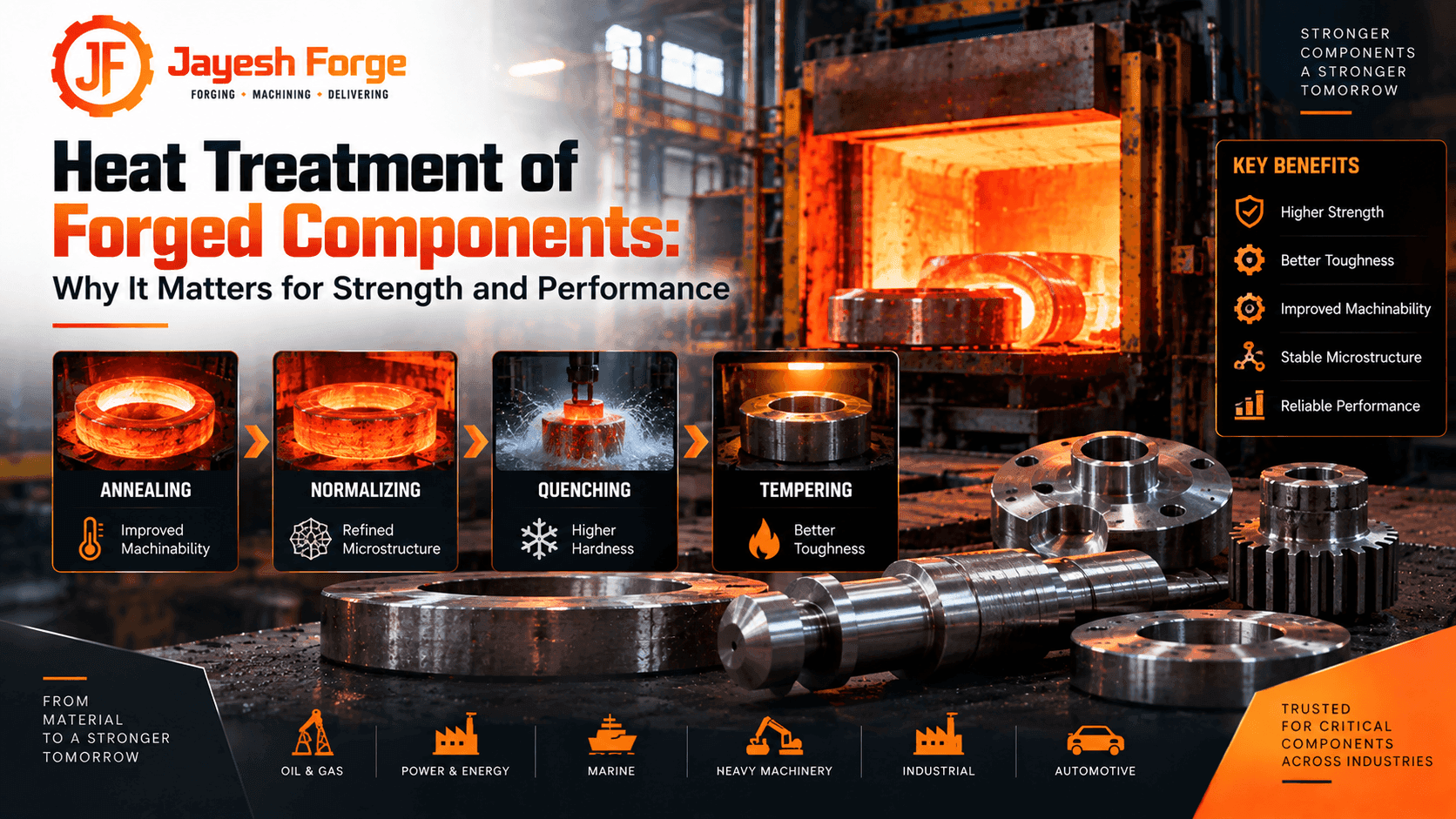
Heat Treatment of Forged Components: Why It Matters for Strength and Performance
Forging creates the component shape, but heat treatment helps achieve the required material condition and mechanical properties. Understand common heat-treatment processes and what engineers should specify when sourcing forged components.
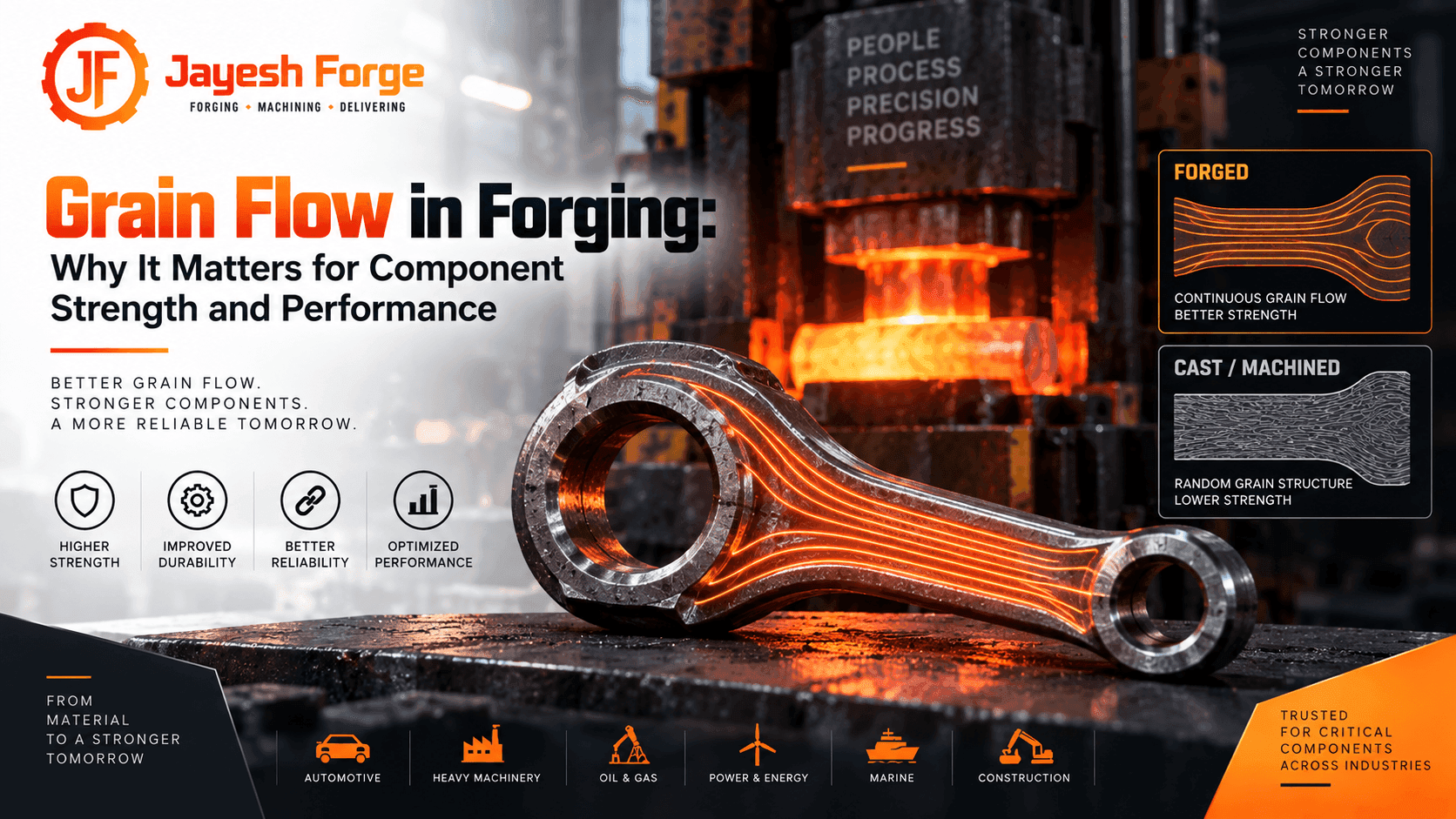
Grain Flow in Forging: Why It Matters for Component Strength and Performance
Grain flow is one of the important characteristics of forged components. Understand how metal deformation influences grain flow and why component geometry, forging direction, reduction, heat treatment and machining must be considered together.